
Table of Contents
ToggleRecording the Dawn Chorus in Brazil — A Field Recordist's 6 AM Story
What does a Brazilian forest sound like at 6 AM?
Most people will never hear a dawn chorus.
If you live in a city, your morning starts with an alarm, traffic, screens. By the time you’re awake, the birds that sang at dawn have gone quiet.
But in the right kind of forest, for about an hour after first light, hundreds of birds sing all at once. Ornithologists call it the dawn chorus.
This is the story of how I recorded one in Brazil — at 6 AM, with light rain falling between the songs.
The Morning of the Recording
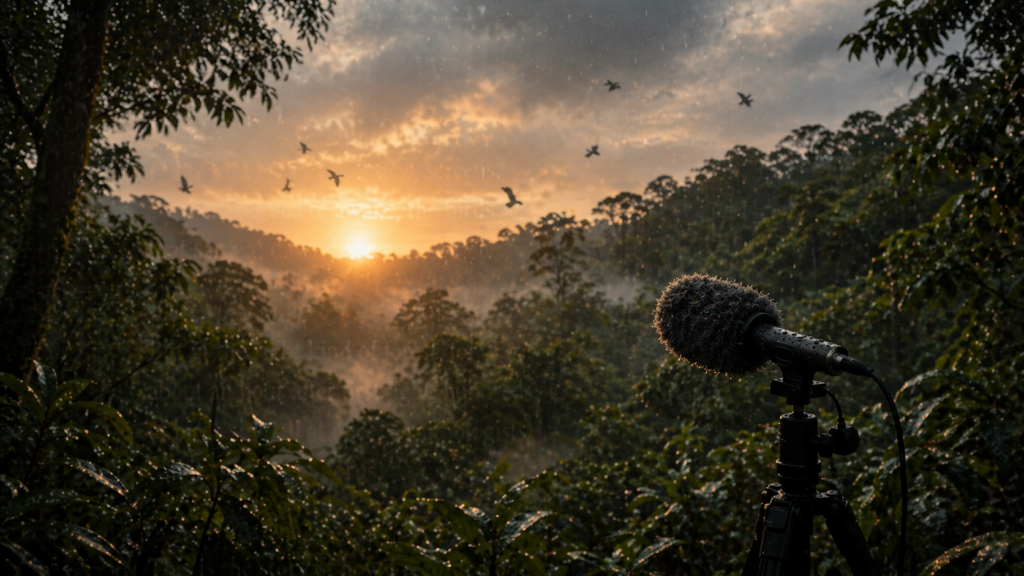
I made this recording at around 6 AM, in a Bahia forest where I lived for years.
A light rain had started falling during the night. It was still falling when the birds began to sing.
That combination was lucky.
For a field recordist, rain usually complicates things. Heavy rain masks bird calls. Wind ruins microphones. But a light, steady rain while birds are singing? That’s a rare combination — soft percussive water on leaves, layered underneath dozens of bird voices.
I set up the recorder on a tripod, checked levels, hit record, and stood still. For a long time.
When I listened back later, I knew I had captured something special.
What You Hear
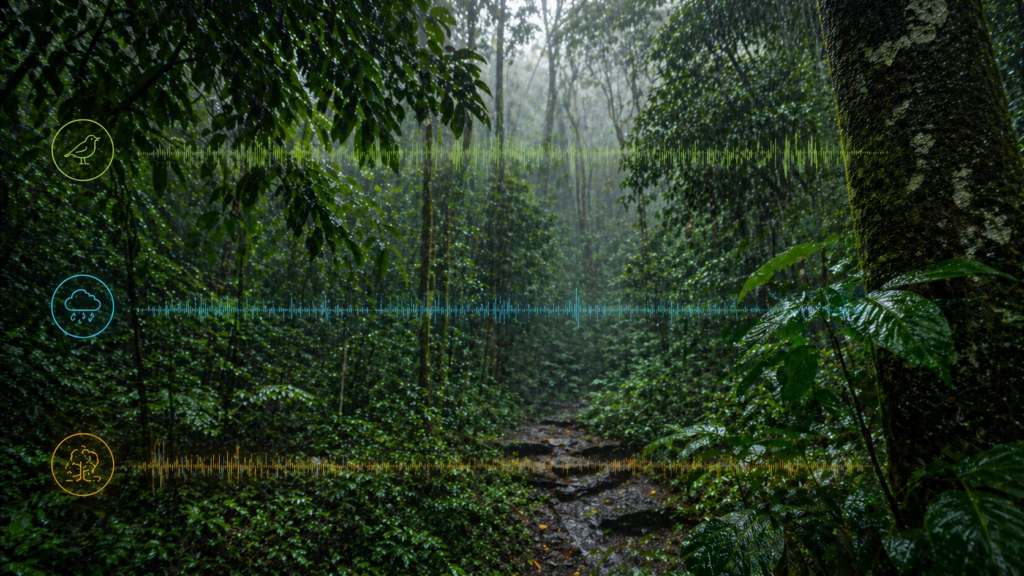
The recording has three distinct layers:
Layer 1: The Bird ChorusMultiple species at different pitches, from different directions. Some sharp and close. Others lower and farther.
Layer 2: The Light RainDrops on leaves at irregular intervals — soft enough that bird calls remain clear, loud enough to provide texture for sleep.
Layer 3: The Forest ItselfWind through vegetation. Distant sounds. The ambient hum of a living ecosystem. Usually edited out of commercial recordings — but it’s what makes a recording feel real.
You can’t synthesize this. You can only go there.
Why It Matters for Sleep
Research on sleep and sound focuses on “pink noise” — the frequency distribution in steady rain and ocean waves. Pink noise helps people fall asleep faster.
But pure noise can feel monotonous. Many people sleep better with layered natural sounds — variation and texture, but continuous enough to soothe.
A dawn chorus with light rain is almost perfectly designed for this:
– Rain provides steady masking
– Bird calls add variation without being jarring
– The complexity quiets an overactive mind
– Spatial cues trigger the brain’s “safety” response
This is why real field recordings matter. The complexity that makes them effective can’t be replicated by audio engineering alone.
What's In AuraDrop
The Bahia dawn chorus is one of many recordings in AuraDrop. Alongside it: rain from Tutunendo Colombia, Amazon ambience from Belém, and recent recordings from Yakushima Japan.
All captured on location with professional binaural microphones. Through headphones, you’re not listening to a recording — you’re standing in the place.
Experience it yourself
Share via: