
Table of Contents
ToggleRecording the Dawn Chorus in Brazil's Cerrado — A Field Recordist's 6 AM Story
What does a Brazilian savanna sound like at 6 AM? The story behind one of AuraDrop's most unusual recordings — and why the dawn chorus matters more than most people realize.
Most people will never hear a dawn chorus. If you live in a city — or even in most of the suburbs — your morning probably starts with an alarm, a coffee machine, traffic noise through the window. By the time you’re fully awake, the birds that were singing at dawn have mostly gone quiet. But in the right kind of forest, for about an hour after first light, hundreds of birds sing all at once. Ornithologists call it the dawn chorus. For field recordists, it’s one of the most prized sounds in nature. This is the story of how I recorded one of those dawn choruses — in Bahia, Brazil, at 6 AM, with a gentle rain falling between the songs.
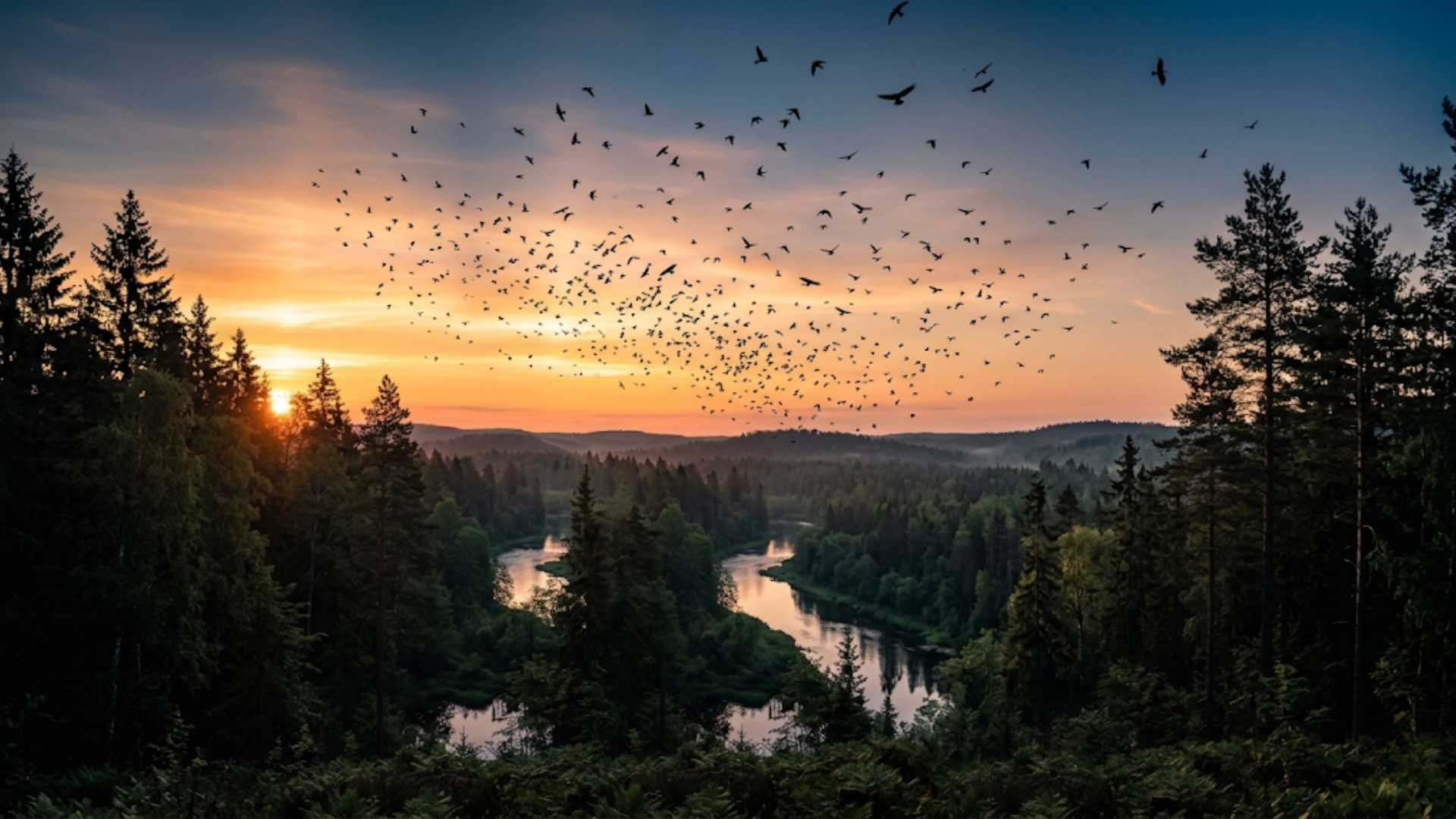
What Is a Dawn Chorus?
A dawn chorus happens when birds — often dozens of different species at once — start singing at first light. It usually lasts about an hour, sometimes less, and then tapers off as the sun rises and the forest’s daytime routine begins. Scientists still debate exactly why birds do this. Some researchers suggest the cooler, quieter morning air carries song farther, so the energy birds spend singing reaches more listeners. Others point to territorial behavior — dawn is when males announce to rivals that they survived the night. Still others emphasize mating, pair bonding, or simply the biological rhythm of waking up. Whatever the reason, the result is one of the most complex, layered natural soundscapes on Earth. In a rich ecosystem, the dawn chorus can contain:
– Dozens of bird species singing simultaneously
– Different pitches and rhythms overlapping
– Spatial depth (some birds near, some far)
– Background textures (wind, leaves, other wildlife)
And unlike most “nature sounds” you’ll find in apps or stock libraries, a real dawn chorus can’t be faked. Loops don’t capture it. AI doesn’t generate it. You have to be there, with the right equipment, at the right time.
Why the Cerrado Matters
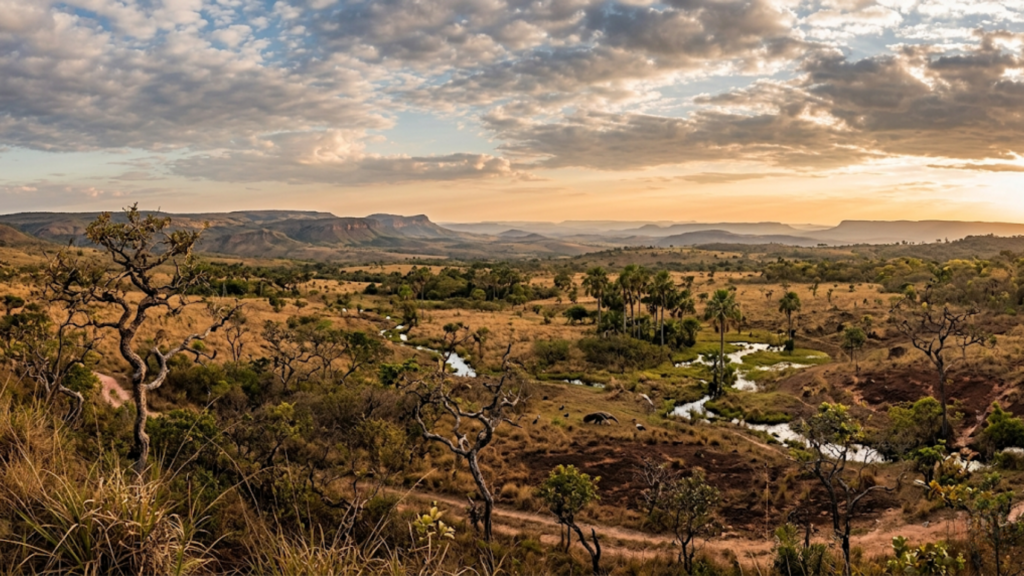
When people talk about Brazilian biodiversity, they usually mean the Amazon. And the Amazon is spectacular — but it’s not the only story. The Cerrado, Brazil’s vast tropical savanna, covers about 20% of the country. It’s one of the most biodiverse savannas on the planet. For some categories of species — particularly plants — the Cerrado has more variety than the Amazon itself. Yet most of the world has never heard of it. I lived in Barreiras, a city in the Cerrado of western Bahia, for nine years. During that time, I watched agriculture expand across the landscape. I also listened — at dawn, at dusk, in the rain and in the dry season — to a soundscape that almost no one outside the region has ever heard properly recorded. The bird species in the Cerrado are different from the Amazon. Some are endemic — they live only here. Their songs are not what you’d hear in a rainforest recording. They belong to a savanna ecosystem that evolved over millions of years. This is what makes Cerrado dawn recordings so rare. They’re not common in sound libraries. They’re not in most nature apps. If you want to hear the Cerrado at 6 AM, you usually have to go there yourself.
The Morning of the Recording
I made this particular recording at around 6 AM, in a section of forest near Barreiras. A light rain had started falling during the night — not a storm, just a gentle patter of drops on leaves — and it was still falling when the birds began to sing. That combination was lucky. For a field recordist, rain usually complicates things. Heavy rain masks bird calls. Wind ruins microphones. Thunderstorms make everything unusable. But a light, steady rain while birds are still singing? That’s a rare combination of textures — soft percussive water hitting leaves, layered underneath dozens of bird voices — and it creates a kind of natural mixing that no studio can reproduce. I set up the recorder on a tripod, checked levels carefully, hit record, and stepped back. The rule of field recording is simple: your own movement is louder than anything you’re trying to record. So I stood still. For a long time. When I listened back later, I knew I had captured something special.
The Equipment
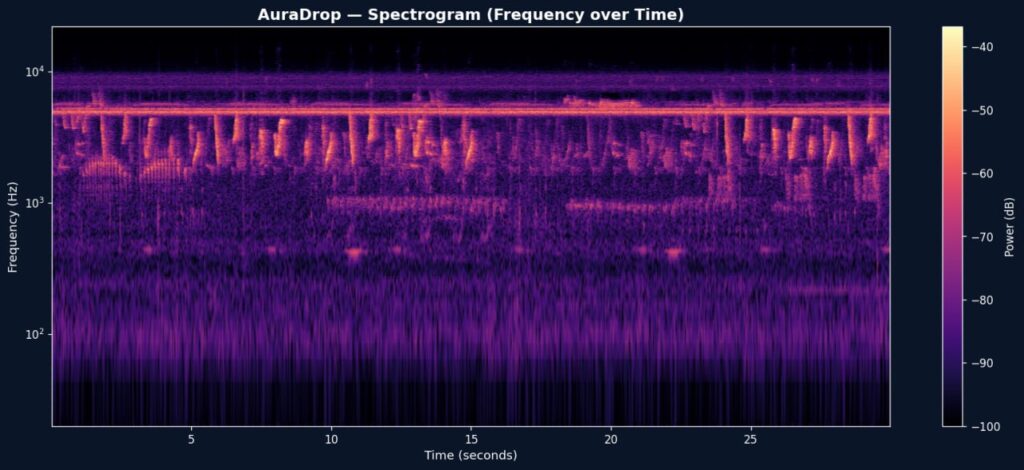
I’ve been recording with Zoom H-series equipment from the very first day I started my YouTube channel — long before AuraDrop existed. Zoom’s handheld recorders are the de facto standard for professional field recording. They offer high-quality preamplifiers, multiple input options, and the kind of rugged reliability you need when you’re recording outdoors for hours at a time. For the Bahia dawn chorus recording, I captured in full stereo with careful attention to level management. When I later analyzed the file technically, a few things stood out: – Zero clipping — the levels were set properly so no peaks were lost – Wide stereo field — left and right channels show genuine spatial separation, not artificial widening – Clean frequency spectrum — concentrated in the 2-8 kHz range where most bird songs live – Natural dynamic range — the quiet parts and loud parts preserve their relationship This is what “uncut” really means. Not just “no loops” — but that the relationship between every sound in the recording is exactly as it was in the forest that morning.
What You Hear
When you listen to this recording — especially through headphones — you hear three distinct acoustic layers:
Layer 1: The Bird Chorus Multiple species singing simultaneously, at different pitches, from different directions. Some calls are high and sharp (smaller birds, closer to the microphone). Others are lower and more resonant (larger species, often farther away). Together they form a complex harmonic texture that changes constantly.
Layer 2: The Light RainDrops hitting leaves at irregular intervals — the quiet, percussive backdrop. It’s loud enough to provide texture and masking (useful for sleep), but soft enough that the bird calls remain clear and distinct.
Layer 3: The Forest Itself Wind moving through vegetation. Distant sounds carried through the morning air. The ambient hum of a living ecosystem. This layer is usually the first thing edited out of commercial nature recordings — and the first thing that makes a recording feel real when it’s left in. Together, these three layers create something that’s neither pure rain sound nor pure bird sound, but a specific moment in a specific place. You can’t synthesize this. You can’t loop it. You can only go there.
Why This Matters for Sleep and Focus
Most research on sound and sleep focuses on “pink noise” — the kind of frequency distribution found in steady rain, ocean waves, and similar natural sounds. Pink noise has been shown to help people fall asleep faster and maintain deeper sleep cycles.
But pure noise, even the pink kind, can feel monotonous. Many people find they sleep better with layered natural sounds — something with more variation and texture, but still continuous enough to be soothing. A dawn chorus with light rain is almost perfectly designed for this purpose, even though no one designed it:
– The rain provides steady, pink-noise-style masking of sudden environmental sounds
– The bird calls add enough variation to keep the sound interesting without being jarring
– The overall complexity occupies just enough attention to quiet an overactive mind
– The natural spatial cues (from binaural recording) trigger the brain’s “safety” response — the unconscious sense of being in a living, non-threatening environment.
This is one reason the recording has become a listener favorite. It’s also one reason why AuraDrop focuses so heavily on real field recordings. The complexity that makes these sounds effective can’t be replicated by any amount of audio engineering.
What's In AuraDrop
The Bahia dawn chorus is one of several “Dawn Forest” recordings included in AuraDrop. Alongside it are the rain recordings from Tutunendo, Colombia — the 2nd rainiest place on Earth — and Amazon rainforest ambience captured during trips to Belém.
Each recording is presented long, uncut, and in full stereo (with automatic binaural switching when you plug in headphones). No loops hide inside the audio. No synthesized elements. What you hear is exactly what mhappened, in the order it happened.
If you’ve been looking for something beyond the typical rain-sound app — something with more depth, more texture, and more of an actual place behind it — this might be the recording that convinces you.
Experience the Cerrado dawn chorus yourself.
The full 3-hour recording is available through AuraDrop. Headphones recommended for the full spatial experience.
Share via: