
Sound therapy focus isn’t a wellness trend. It’s a biological mechanism one that has been measured by electroencephalography (EEG), validated in peer-reviewed journals, and now backed by a global market that reached $2.54 billion in 2024 and is projected to double to $5.08 billion by 2033 (Straits Research, 2025).
Here’s what most people don’t know: your brain does not passively receive sound. It synchronises with it. Within milliseconds of encountering a sustained auditory frequency, neural oscillations begin to shift and with the right sound protocol, a scattered, cortisol-flooded mind can enter a state of deep, sustained attention in under three minutes. This article explains exactly why that happens, supported by the latest neuroscience, clinical data, and market evidence from 2024–2026.
Whether you’re an executive fighting a chronic focus deficit, a student buried in cognitive overload, or a wellness professional building programmes for clients, understanding the mechanics of sound therapy for focus is no longer optional it’s a competitive advantage.
KEY STATISTICS
$5.08B Sound therapy market by 2033 (Straits Research) | 41% Global workers report “a lot of stress” — Gallup 2024 | 0.46 SMD cognitive boost via music therapy (meta-analysis, 2026) | 40 Hz Gamma frequency with the strongest focus evidence |
Table of Contents
Toggle01 Brainwave Entrainment Rewires Your Focus Frequency
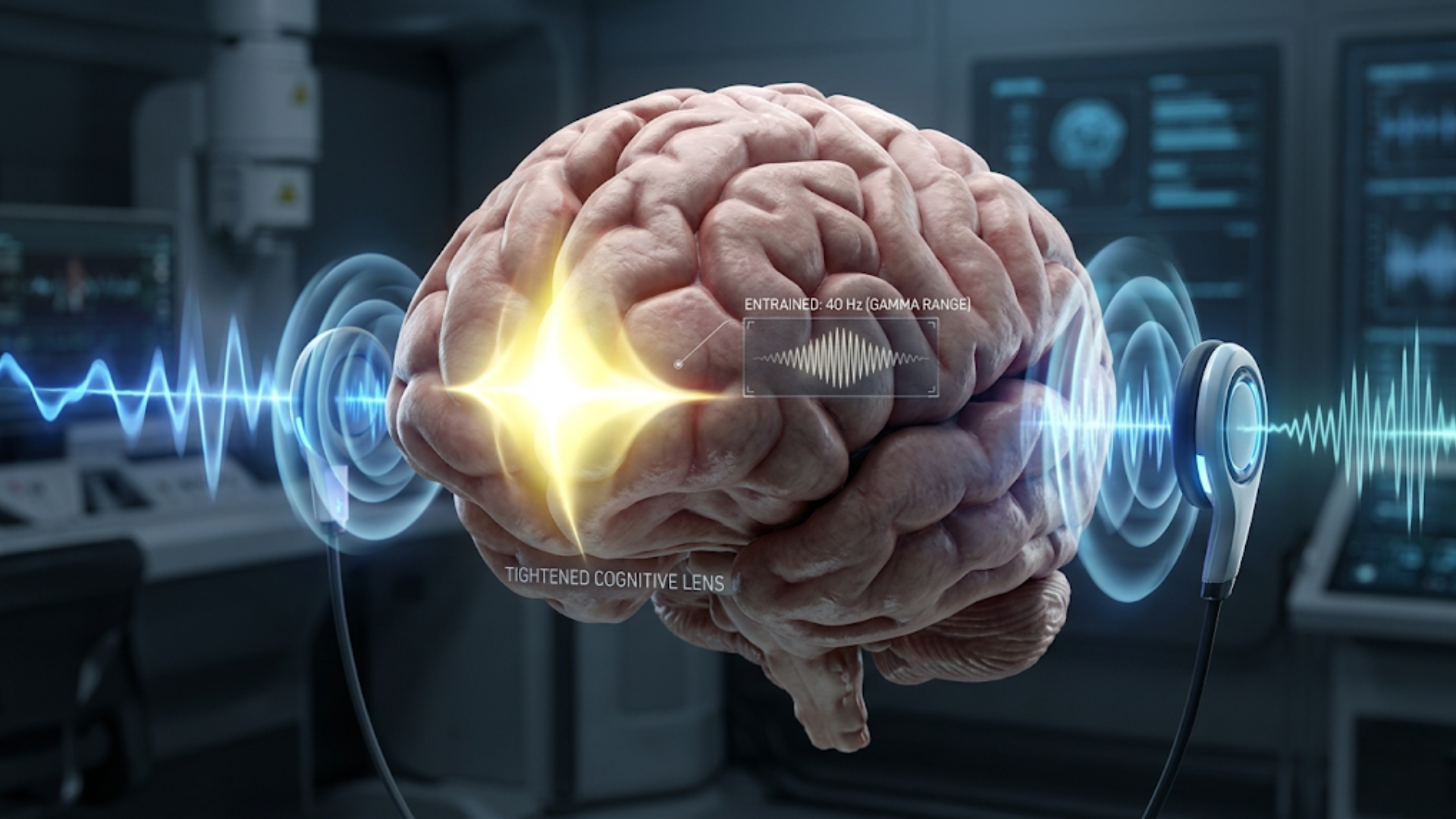
The most profound mechanism behind sound therapy focus is a phenomenon neuroscientists call brainwave entrainment the brain’s innate tendency to synchronise its electrical activity with an external rhythmic stimulus. This isn’t metaphor. It is measurable, repeatable physics applied to neurology.
Your brain produces five primary categories of electrical oscillation. Focus lives in two of them: beta waves (13–30 Hz) the frequency of active, engaged, problem-solving cognition and gamma waves (30–100 Hz), associated with peak cognitive binding, heightened perception, and moments of sharp insight. When you are distracted, anxious, or mentally fatigued, your brain is producing too much theta (daydreaming) or alpha (relaxed idling) relative to the beta and gamma states you need.
Sound therapy, specifically through a technique called binaural beats, can engineer this shift. When a tone of, say, 200 Hz is delivered to your left ear and 240 Hz to your right, your brain perceives a phantom “beat” oscillating at the difference: 40 Hz the gamma range. Your neural architecture then begins to synchronise toward that frequency, pulling your cognitive state toward sharper, more concentrated attention.
“Gamma-frequency binaural beats bias the individual attentional processing style towards a reduced spotlight of attention in other words, they tighten the cognitive lens.”
— Colzato et al., Leiden University, Psychological Research (2015), PMC5233742
A 2018 meta-analysis examining 22 separate studies confirmed that binaural beats can boost cognition including memory and sustained attention with effectiveness depending on frequency, duration of exposure, and timing. The 2025 University of Texas study led by neuroscience researcher Anastasiia Melnichuk went further: their EEG data confirmed that gamma-frequency beats at low pitch and combined with white noise improved overall attention. Their recordings showed the brain was actually entraining at the presented frequencies not merely responding emotionally to pleasant sound, but restructuring its electrical architecture in real time.
🗓 BRAINWAVE CHEAT SHEET FOR FOCUS
Wave | Frequency | Cognitive State | Focus Target? |
Delta | 0.5–4 Hz | Deep sleep, unconscious | No |
Theta | 4–8 Hz | Daydreaming, distraction | Reduce |
Alpha | 8–13 Hz | Relaxed, creative flow | For creative: Yes |
Beta | 13–30 Hz | Active thinking, alert focus | Primary target ✓ |
Gamma | 30–100 Hz | Peak cognition, insight | Strongest evidence ✓✓ |
💡 TRUTH BOMB
You cannot voluntarily command your brain into beta or gamma focus. But you can use sound therapy to acoustically engineer your way there bypassing willpower entirely. That’s not wellness woo. That’s applied electrophysiology.
02 Sound Therapy Crushes the Cortisol That’s Killing Your Concentration
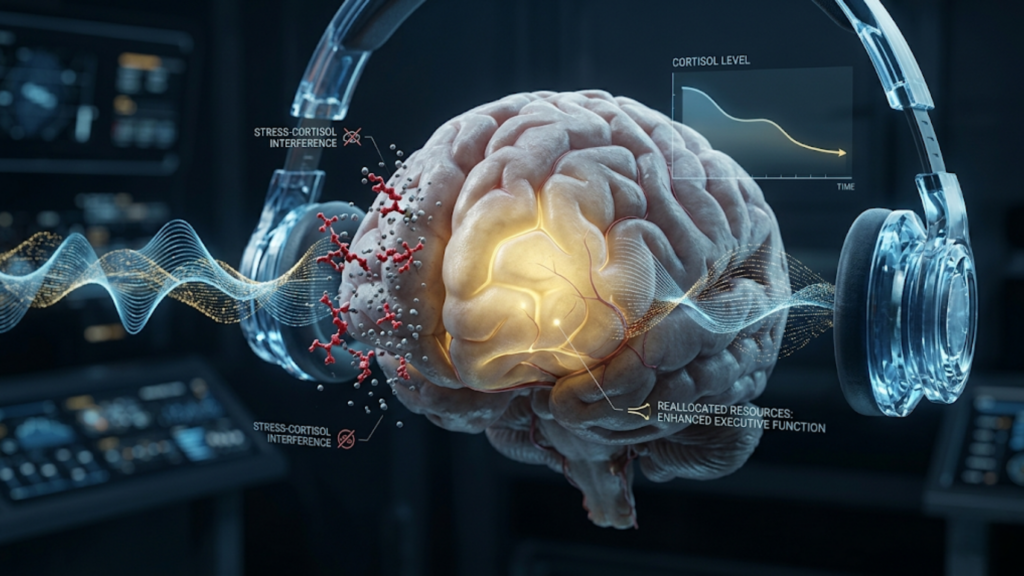
You already know stress is bad. But here’s what most productivity gurus won’t tell you: the physiological mechanism by which stress destroys focus is cortisol’s direct interference with the prefrontal cortex the very region of the brain responsible for executive function, working memory, and sustained attention.
Gallup’s 2024 Global Workplace Report found that 41% of employees worldwide experience “a lot of stress.” A separate 2024 burnout study found that 42% of women in the workforce reported burnout symptoms. Depression alone reduces cognitive task completion by 35% (ClinicalTrials.gov, NCT05120310). This is the true context in which sound therapy for focus operates it isn’t a luxury enhancement for people who already have great focus. It’s a cortisol-suppression mechanism for people whose biology is actively working against them.
The Science of Sound vs. Cortisol
A landmark 2025 scoping review published in JMIR Mental Health synthesised 34 studies from 1990 to 2024 and produced a clear verdict: music interventions especially classical music and self-selected pieces “effectively reduce physiological stress markers, including cortisol levels, heart rate variability, and blood pressure” (Saskovets, Saponkova & Liang, 2025). The researchers specifically measured salivary cortisol the gold-standard biomarker of stress response and found consistent suppression across multiple study designs.
A separate 2024 systematic review on natural sounds confirmed the same cortisol-suppression pathway: increased exposure to natural acoustic environments was associated with decreased salivary cortisol, reduced state anxiety, lower systolic and diastolic blood pressure, and improved restorative outcomes. Nature sounds work through the autonomic nervous system, shifting the body from sympathetic (fight-or-flight, cortisol-generating) to parasympathetic (rest-and-repair, focus-enabling) dominance.
“Music listening is strongly associated with stress reduction by the decrease of physiological arousal as indicated by reduced cortisol levels, lowered heart rate, and decreases in mean arterial pressure.”
— Linnemann et al., 2015 — cited in Music Therapy for Stress Reduction meta-analysis (Taylor & Francis)
📊 THE CORTISOL–FOCUS LINK — BY THE NUMBERS
- 41% of global employees report “a lot of stress” (Gallup, 2024)
- 35% reduction in cognitive task performance caused by depression-level stress
- 34 peer-reviewed studies confirm sound reduces cortisol, HR, and blood pressure (JMIR, 2025)
- Classical & self-selected music show the strongest consistent cortisol suppression
- Nature sounds shift ANS from sympathetic to parasympathetic within minutes
Here is the insight most practitioners miss entirely: you cannot focus while cortisol is elevated, because high cortisol literally narrows blood flow to the prefrontal cortex while amplifying the amygdala (your threat-detection, emotionally reactive brain region). Sound therapy does not just “help you relax.” It chemically reconfigures the brain’s resource allocation so that the region capable of focus gets the blood and glucose it needs.
03 Therapeutic Sound Activates Dopamine Your Brain’s Focus Fuel
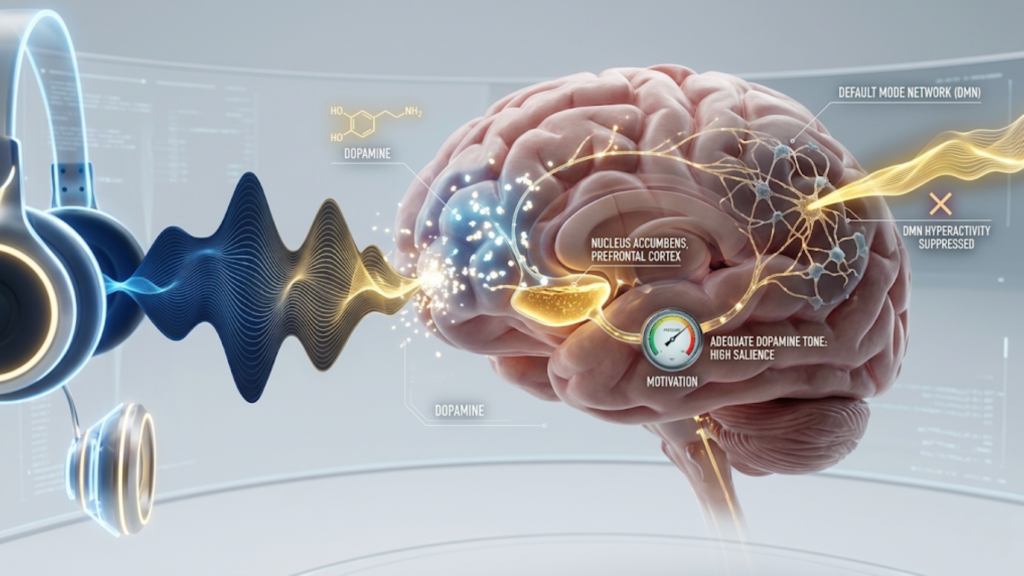
Dopamine is not just the “reward” chemical. In 2025 neuroscience, it is understood as the brain’s primary salience and motivation signal the chemical that tells your prefrontal cortex that a task is worth sustained attention. Without adequate dopamine tone, focus is biologically impossible. This is exactly why ADHD, which involves dysregulated dopamine signalling, produces such profound attention deficits.
Sound therapy, and music-based interventions specifically, engage the brain’s dopaminergic reward circuitry in a way that almost no other non-pharmacological stimulus can replicate. A landmark 2026 meta-analysis published in Frontiers in Public Health synthesising data from 14 studies conducted between 2010 and 2025 found a statistically significant improvement in cognitive function (SMD = 0.46, 95% CI: 0.26 to 0.67) following music therapy interventions. The researchers explicitly identified modulation of the dopaminergic system and default mode network connectivity as the primary neurological mechanisms (Mulia et al., 2026, Frontiers in Public Health, DOI: 10.3389/fpubh.2025.1735470).
The Default Mode Network Problem
Here is a mind-blowing insight almost no sound therapy article discusses: your greatest enemy when trying to focus isn’t external distraction. It’s your brain’s own default mode network (DMN) the neural system that activates when you’re not focused on anything specific: mind-wandering, self-referential thought, rumination.
The DMN and the executive attention network are anti-correlated: when one is active, the other suppresses. When you can’t focus, your DMN has essentially “won” the competition for neural resources. The 2026 Frontiers meta-analysis found that music therapy reduces DMN hyperactivity suppressing mind-wandering and allowing the executive attention network to assert dominance. Sound therapy focus techniques don’t just help you concentrate. They suppress the network that prevents concentration.
💡 TRUTH BOMB
ADHD brains, where dopamine regulation is atypical, show measurable benefit from consistent acoustic input (like lo-fi music) because it provides the steady sensory stimulation needed to reduce hyperactivity and regulate the attention system without pharmaceuticals.
A 2025 review from King’s College London, published in Frontiers in Digital Health (DOI: 10.3389/fdgth.2025.1552396), synthesised evidence on brainwave entrainment and AI-driven biofeedback, concluding that these methodologies offer a “unified therapeutic paradigm” for both emotional dysregulation and cognitive deficits with dopaminergic modulation as a key proposed mechanism.
04 Sound Masks the Cognitive Noise That Fragments Attention
Not all sound therapy focus mechanisms work through the brain. Some work by managing the acoustic environment that the brain has to process. This is the most under-discussed and practically powerful dimension of sound therapy, with applications for workplaces, classrooms, and home offices.
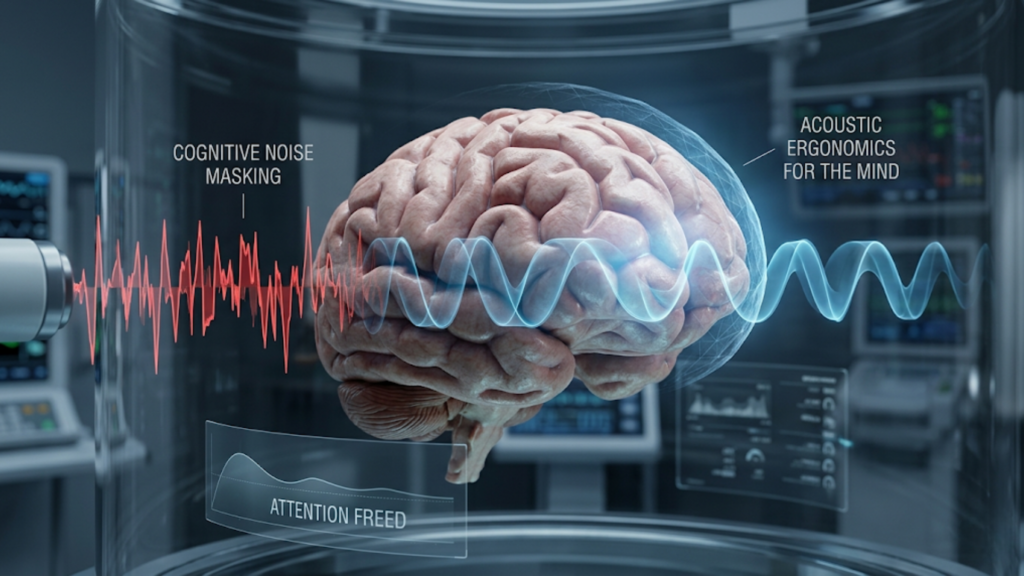
A landmark study published in Frontiers in Computational Neuroscience (Haruvi et al., 2022, DOI: 10.3389/fncom.2021.760561) used brain-computer interface technology to measure, with millisecond precision, the effect of different types of audio on focus in everyday environments. The findings were counterintuitive and commercially significant: the sound properties that most powerfully increased focus were not about genre or melody they were about acoustic predictability and cognitive load. Sounds that demanded attention (lyrics, unpredictable rhythms, high emotional content) actively fragmented focus. Sounds with structured, predictable acoustic patterns freed the brain’s attentional resources for the task at hand.
The 70 dB Inflection Point
Research consistently identifies a critical noise threshold for cognitive performance. Ambient noise at approximately 70 decibels roughly the level of a coffee shop has been shown to enhance creative cognition relative to near-silence (55 dB) or loud environments (85+ dB). This is why the coffee-shop effect is real: a certain level of structured acoustic complexity occupies the brain’s background-monitoring system, reducing the likelihood of intrusive thoughts while maintaining alertness. Sound therapy protocols can engineer this sweet spot deliberately replacing chaotic office noise with calibrated therapeutic soundscapes.
📡 SOUND PROPERTIES THAT MAXIMISE FOCUS (BCI Research, 2022)
- Predictable acoustic patterns → free attentional resources for deep work
- No lyrics → avoid phonological loop interference (competing with inner language)
- Moderate tempo (60–80 BPM) → aligns with resting heart rate, reduces ANS arousal
- Nature sounds + white noise → improve general attention (2025 UT Austin EEG study)
- Classical & “sombre” tonal music → highest focus improvement in CHI 2021 EEG study
The pre-competitive insight here the one almost no company in the sound therapy space has fully articulated is that sound therapy focus is not just about what you add. It is about what it replaces. Every minute your brain spends processing unpredictable, emotionally loaded acoustic noise is a minute of prefrontal executive bandwidth spent on monitoring rather than creating. Sound therapy reclaims that bandwidth at a physiological level. It is acoustic ergonomics for the mind.
05 Sustained Sound Therapy Builds Long-Term Neural Plasticity for Focus
The first four reasons explain why sound therapy helps you focus right now. This fifth reason explains why consistent sound therapy practice helps you become a fundamentally more focused person over months a distinction that elevates sound therapy from a productivity hack to a genuine cognitive training methodology.
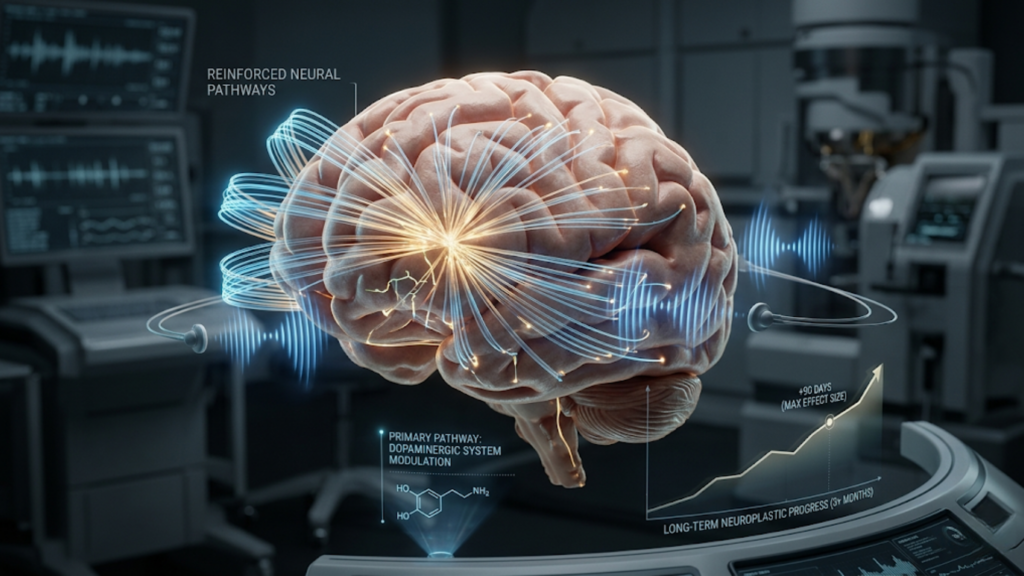
Neuroplasticity is the brain’s ability to reorganise its structure and function in response to repeated stimulation. Every time you use a targeted sound therapy protocol to access a beta or gamma state, you are not just borrowing that state for the duration of the session. You are reinforcing the neural pathways that produce it. Think of it as supervised exercise for your attentional circuits.
“Auditory-based music therapy may facilitate neuroplasticity via modulation of the dopaminergic system and default mode network connectivity.”
— Mulia et al., Frontiers in Public Health, January 2026 (DOI: 10.3389/fpubh.2025.1735470)
The 2026 Frontiers meta-analysis found that the cognitive benefits of music therapy were significantly larger in interventions lasting more than 3 months (SMD = 0.62, 95% CI: 0.05 to 1.20), compared to shorter programmes compelling evidence that neuroplastic change, not just acute physiological response, is accumulating with sustained practice. The effect size almost doubled when the protocol was sustained beyond the 90-day mark.
The Ancient–Modern Convergence
Here is the single most authoritative perspective in this entire conversation: every major ancient culture on earth independently arrived at the conclusion that structured sound facilitates altered states of higher cognition. Gregorian chanting. Shamanic drumming. Vedic mantra. Tibetan singing bowls. The 432 Hz instruments of classical Indian raga. These are not coincidences. They are convergent discoveries, made independently across millennia, of the same underlying neurological truth.
Modern EEG technology didn’t discover what sound therapy does to the focused brain. It confirmed what human beings had empirically observed for thousands of years and gave us the tools to engineer it with precision. As King’s College London’s 2025 review concluded, the integration of music therapy, brainwave entrainment, and AI-driven biofeedback represents a “bridge between ancient wisdom and scientific understanding” with legitimate clinical application in cognitive rehabilitation.
📈 NEUROPLASTICITY RESULTS FROM LONG-TERM SOUND THERAPY
- SMD 0.46 cognitive improvement overall (14-study meta-analysis, 2026)
- SMD 0.62 for programmes lasting 3+ months nearly double the short-term effect
- Passive listening-based therapies showed the largest neuroplastic effects
- Publications post-2019 show larger effects, reflecting better protocol design and longer durations
- Dopaminergic system modulation confirmed as the primary neuroplastic pathway
By 2025, this understanding has catalysed major institutional investment. In November 2024, the Shanghai Conservatory of Music and Huashan Hospital (Fudan University) jointly launched a Key Laboratory of Artificial Intelligence Music Therapy explicitly targeting neuroplasticity. In October 2024, Skift Meetings documented a growing trend of embedding sound healing into corporate sessions specifically to enhance creativity and cognitive performance among professional participants. The era of sound therapy focus as mainstream neurocognitive protocol has already begun.
🎧 How to Start a Sound Therapy Focus Practice
Understanding the science is step one. Implementing it is where transformation actually occurs. Here is a research-informed entry protocol for anyone beginning a sound therapy focus practice:
✓ THE EVIDENCE-BASED SOUND THERAPY FOCUS PROTOCOL
- Equipment: Stereo headphones are essential for binaural beats (the two-channel frequency differential requires separate ear delivery). For ambient soundscapes, speakers are sufficient.
- Frequency selection: For deep analytical work 40 Hz gamma binaural beats with white noise. For creative problem-solving alpha (8–12 Hz) binaural beats. For sustained reading or learning low beta (15–18 Hz).
- Duration: Minimum 15–30 minutes per session. Expect the first 5–8 minutes to be a transition period.
- Volume: Keep below 70 dB (soft enough that you could hold a conversation over it). Loud sound therapy is ineffective and potentially harmful.
- Consistency: The neuroplasticity research is unambiguous 90+ days of consistent use produces the largest cognitive gains. Treat it as a practice, not a supplement.
- Contraindications: Binaural beats are not recommended for individuals with epilepsy, cardiac pacemakers, or those prone to seizures without medical supervision.
The Bottom Line
Sound therapy focus works through five compounding mechanisms: brainwave entrainment that rewires your operating frequency; cortisol suppression that removes the chemical barrier to concentration; dopaminergic activation that makes sustained attention feel intrinsically rewarding; acoustic masking that reclaims prefrontal bandwidth from environmental chaos; and sustained neuroplasticity that makes focused states progressively easier to access over time.
This is not a soft wellness practice for people who already have their lives together. It is a neuroscientifically grounded intervention for a world where 41% of workers are chronically stressed and cognitive overload is the default human condition. The $3.2 billion global sound healing market and the 7.6%+ annual growth rate confirm that the world is beginning to understand what ancient cultures never forgot: sound is medicine. And specifically, sound is focus medicine.
The question is no longer whether sound therapy for focus works. The question is how quickly you will integrate it.
REFERENCES & SOURCES
- Mulia GJ et al. (2026). Cognitive enhancement through music therapy: meta-analytic evidence across clinical populations. Frontiers in Public Health. DOI: 10.3389/fpubh.2025.1735470
- Saskovets M, Saponkova I, Liang Z. (2025). Effects of Sound Interventions on the Mental Stress Response in Adults: Scoping Review. JMIR Mental Health. DOI: 10.2196/69120
- Jiao D. (2025). Advancing personalized digital therapeutics: integrating music therapy, brainwave entrainment methods, and AI-driven biofeedback. Frontiers in Digital Health. DOI: 10.3389/fdgth.2025.1552396
- Haruvi A et al. (2022). Measuring and Modeling the Effect of Audio on Human Focus in Everyday Environments Using Brain-Computer Interface Technology. Frontiers in Computational Neuroscience. DOI: 10.3389/fncom.2021.760561
- Colzato LS et al. (2015). More attentional focusing through binaural beats. Psychological Research. PMC5233742
- Melnichuk A et al. (2025). Gamma-frequency binaural beats and white noise improve general attention. University of Texas at Austin.
- Straits Research. (2025). Global Sound Therapy Market Size, Share, and Forecast 2025–2033.
- Metatech Insights. (2025). Sound Healing Market Report 2025–2035.
- Gallup. (2024). State of the Global Workplace Report.
- Mulia GJ et al. (2024). The Sound of Memory: Investigating Music Therapy’s Cognitive Benefits in Patients with Dementia. Journal of Personalized Medicine. DOI: 10.3390/jpm14050497
Share via: