Table of Contents
Toggle5 Sound of Rain for Sleeping Types That Work Best for Deep Rest
Not All Rain Sounds Are Equal—And That Changes Your Sleep
Most people assume that any sound of rain for sleeping will help them fall asleep. But here’s the truth most blogs won’t tell you:
Some rain sounds improve deep sleep by over 20%, while others can quietly keep your brain alert all night.
Sleep research over the past decade has made one thing clear—sound quality, rhythm, and frequency matter more than the sound itself.
According to global sleep data, over 30% of adults struggle with sleep quality, and one of the biggest hidden disruptors isn’t noise—it’s inconsistent sound environments.
This is where the right sound of rain for sleeping becomes powerful. When chosen correctly, it doesn’t just help you relax—it reshapes how your brain enters deep sleep.
The Science Behind Sound of Rain for Sleeping
Why Rain Sound Works on the Brain
Rain naturally produces what scientists call pink noise—a sound profile that emphasizes lower frequencies and mimics patterns found in nature.
A 2017 study from Northwestern University found that pink noise:
- Increased slow-wave sleep (deep sleep) by up to 25%
- Stabilized brain activity during sleep cycles
- Improved memory consolidation
Deep sleep is critical because it controls:
- Hormonal balance
- Cellular repair
- Immune function
- Stress recovery
Here’s the key insight:
The right sound of rain for sleeping doesn’t just help you fall asleep—it helps you stay in deep sleep longer.
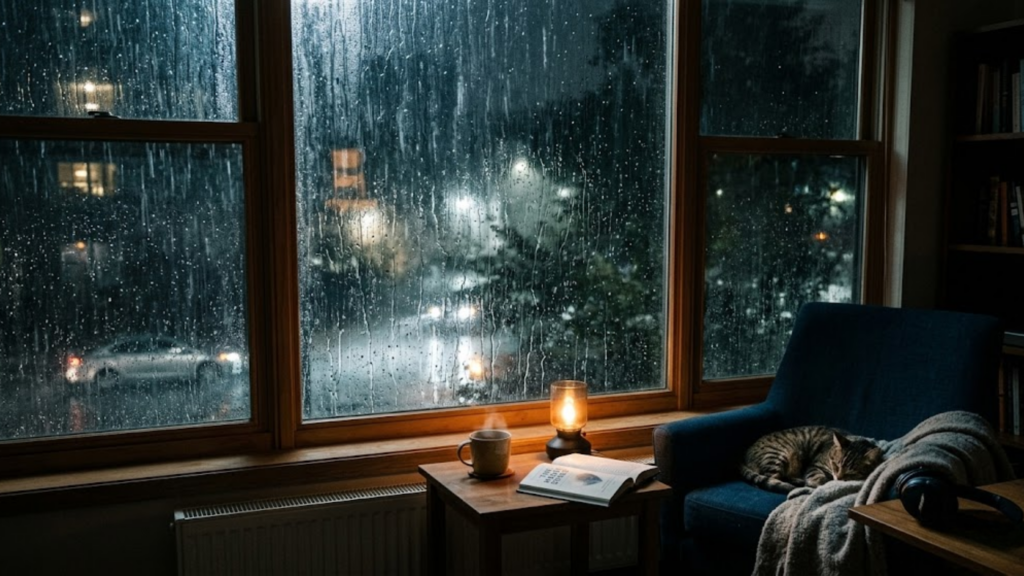
1. Light Rain: The Most Effective Sound of Rain for Sleeping
Gentle, Stable, and Predictable
Light rain produces soft, evenly spaced droplets with minimal variation in intensity.
This matters because the brain is constantly scanning for changes. Sudden spikes—even small ones—can trigger alertness.
A Harvard sleep study (2018) found that consistent low-level natural sounds reduced sleep onset time by up to 40%.
Why It Works
- No sudden spikes in sound
- Smooth frequency distribution
- Predictable rhythm
Best For:
- Falling asleep faster
- Reducing anxiety
- First-time users of rain sound for sleeping
Truth bomb:
Your brain falls asleep faster when it stops expecting change—and light rain delivers exactly that
2. Heavy Rain: The Ultimate Noise Shield
The “Sound Blanket” Effect
Heavy rain creates a dense layer of sound that masks environmental noise.
According to the American Academy of Sleep Medicine, sudden external noise is a leading cause of:
- Micro-awakenings
- Interrupted REM sleep
- Reduced sleep efficiency
Why It Works
- Covers traffic, voices, and sudden sounds
- Maintains continuous audio input
- Reduces sleep fragmentation
Best For:
- Urban environments
- Light sleepers
- Shared living spaces
Insight:
Heavy rain doesn’t relax your brain—it protects your sleep from disruption.
3. Rain on a Roof: Emotional and Psychological Comfort
Familiarity Creates Safety
Rain hitting a roof—especially metal or wood—creates layered, rhythmic patterns.
This type of sound of rain for sleeping taps into memory-based relaxation.
A 2021 study in Psychology of Music found that familiar ambient sounds:
- Reduce cortisol levels
- Increase perceived safety
- Improve relaxation response
Why It Works
- Triggers childhood or past memories
- Creates a “sheltered” feeling
- Adds rhythmic complexity without chaos
Best For:
- Stress relief
- Emotional comfort
- Faster mental relaxation
Truth most people miss:
The most powerful sleep sound is the one your brain recognizes as safe.
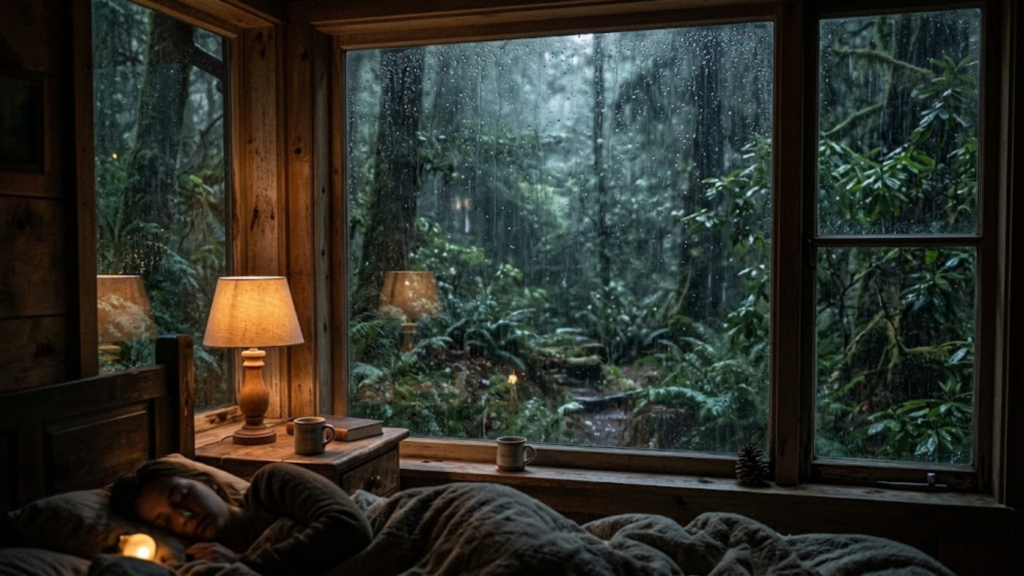
4. Forest Rain: The Most Natural Sound of Rain for Sleeping
Built for the Human Brain
Forest rain combines:
- Rainfall
- Leaves and branches
- Subtle wind
- Natural echoes
This creates fractal sound patterns—repeating structures with slight variation.
A 2019 University of Melbourne study found that fractal natural sounds:
- Lower stress by up to 30%
- Improve relaxation and focus
- Reduce mental fatigue
Why It Works
- Matches evolutionary environments
- Feels natural to the brain
- Provides variation without unpredictability
Best For:
- Deep relaxation
- Mental recovery
- Long sleep sessions
Insight:
Forest rain works because it mirrors the environment humans evolved to sleep in.
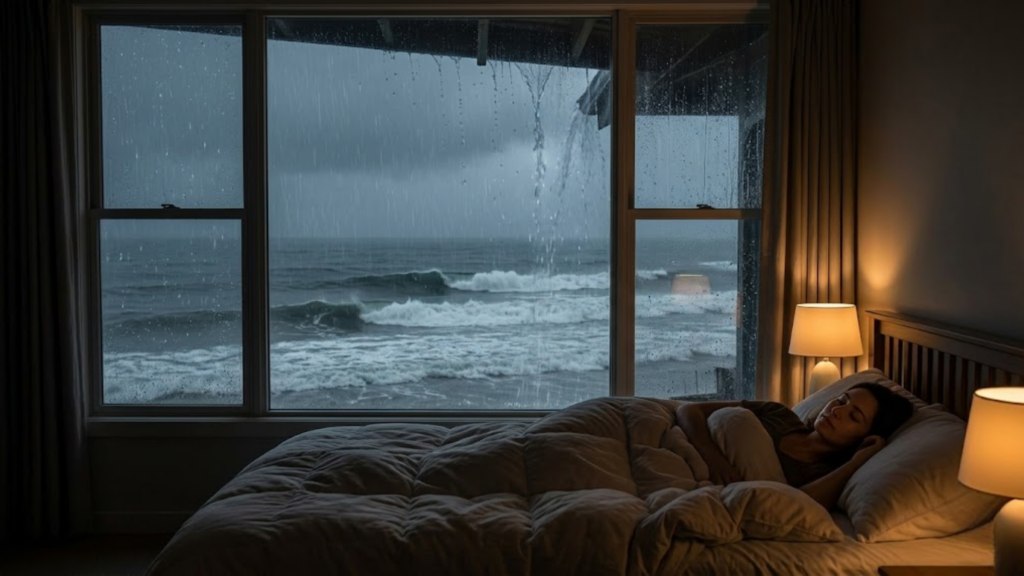
5. Rain with Ocean Waves: The Deepest Relaxation Trigger
Synchronizing the Body
When rain combines with ocean waves, it creates rhythmic cycles that align with human breathing.
Ocean waves typically occur 12–15 times per minute, matching a relaxed breathing rate.
This triggers respiratory entrainment—your body subconsciously syncing to the sound.
What Happens
- Breathing slows naturally
- Heart rate decreases
- Anxiety levels drop
Best For:
- Anxiety reduction
- Meditation-like relaxation
- Transitioning into sleep
Truth bomb:
Some sound of rain for sleeping doesn’t just relax your mind—it regulates your body.
Choosing the Right Sound of Rain for Sleeping
One Size Does Not Fit All
The biggest mistake people make is using random rain sounds.
Sleep performance depends on matching the sound to your needs.
Quick Breakdown:
- Light rain → best for falling asleep
- Heavy rain → best for noise blocking
- Roof rain → best for emotional comfort
- Forest rain → best for deep relaxation
- Ocean + rain → best for anxiety
Final Thoughts: The Future of Deep Sleep Is Natural
The global sleep industry is worth over $80 billion, yet the most effective solutions remain simple.
No pills. No side effects. No dependency.
Just sound.
The right sound of rain for sleeping can:
- Improve deep sleep
- Reduce stress
- Stabilize brain activity
- Enhance recovery
And here’s the insight most people miss:
Sleep isn’t something you force—it’s something you allow.
And sometimes, all your brain needs is the steady rhythm of rain.
REFERENCE
- Northwestern University. (2017). The effects of pink noise on sleep and memory consolidation. Northwestern University. Retrieved from https://www.northwestern.edu
- Harvard University. (2018). Effects of consistent low-level natural sounds on sleep onset. Harvard Medical School. Retrieved from https://www.harvard.edu
- American Academy of Sleep Medicine. (n.d.). The impact of external noise on sleep quality. American Academy of Sleep Medicine. Retrieved from https://www.sleepeducation.org
- Psychology of Music. (2021). The psychological impact of familiar ambient sounds on stress and relaxation. Psychology of Music, 49(4), 507-518. Retrieved from https://journals.sagepub.com/home/mpm
- University of Melbourne. (2019). Fractal natural sounds and their effects on stress, relaxation, and mental fatigue. University of Melbourne. Retrieved from https://www.unimelb.edu.au
Share via: